


T-BAGS seismic base isolation system
A safe, reliable, and low-cost construction system for reducing building shaking during earthquakes
The T-BAGS seismic base isolation system is a safe and reliable system in which specially designed sandbags, stacked in two layers, slide during an earthquake to dampen seismic vibrations before they are transmitted to the building.
- Share this article
What is the T-BAGS seismic base isolation system?

Patents
Seismic base isolation foundation system and its application method
Patent No.: 5196059
Date of Acquisition: February 15, 2013
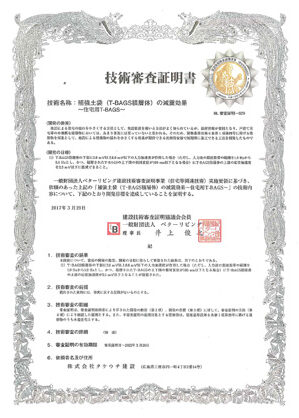
Certification

T-BAGS (reinforced soil bags for settlement control of foundation systems) BL Certification No. 015
Seismic Base Isolation System Based on the
“Slippage” Mechanism of T-BAGS
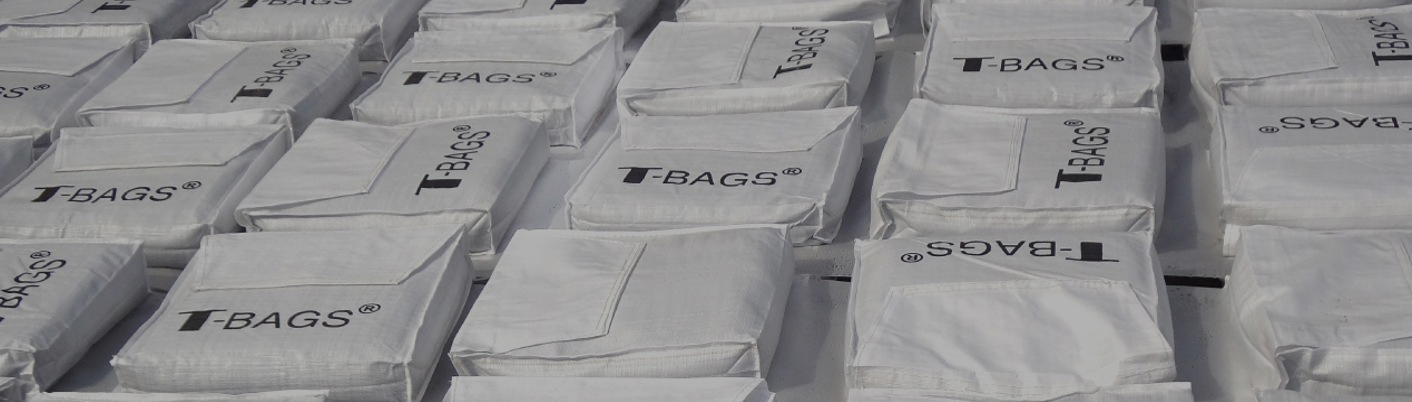
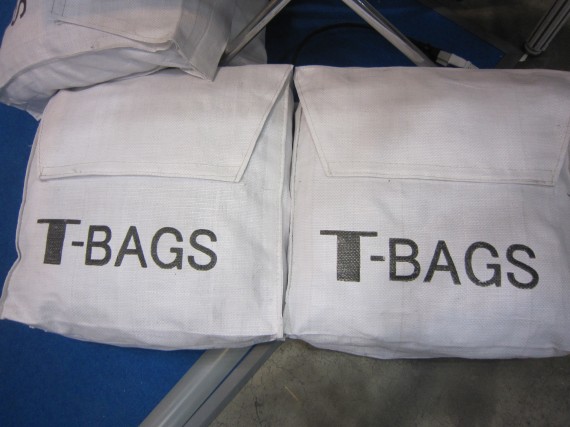
T-BAGS consist of polypropylene bags filled with uniformly graded sand. These bags are stacked in two layers and laid across the entire area beneath a foundation.
During an earthquake, slippage occurs between the upper and lower layers of the bags, which mitigates seismic motion and reduces the vibrations transmitted to the building.
Safety and Reliability Concept Behind the
T-BAGS Seismic Base Isolation Method
Buildings in Japan are designed with a high level of seismic strength, and major structural damage from earthquakes is uncommon. However, when buildings experience strong shaking, the following issues remain:
- People inside the building may experience intense fear and anxiety.
- During a major earthquake, strong shaking makes it difficult for people to move and evacuate safely.
In other words, simply “non-collapse” is not enough to provide true peace of mind.
Minimizing Building Motion
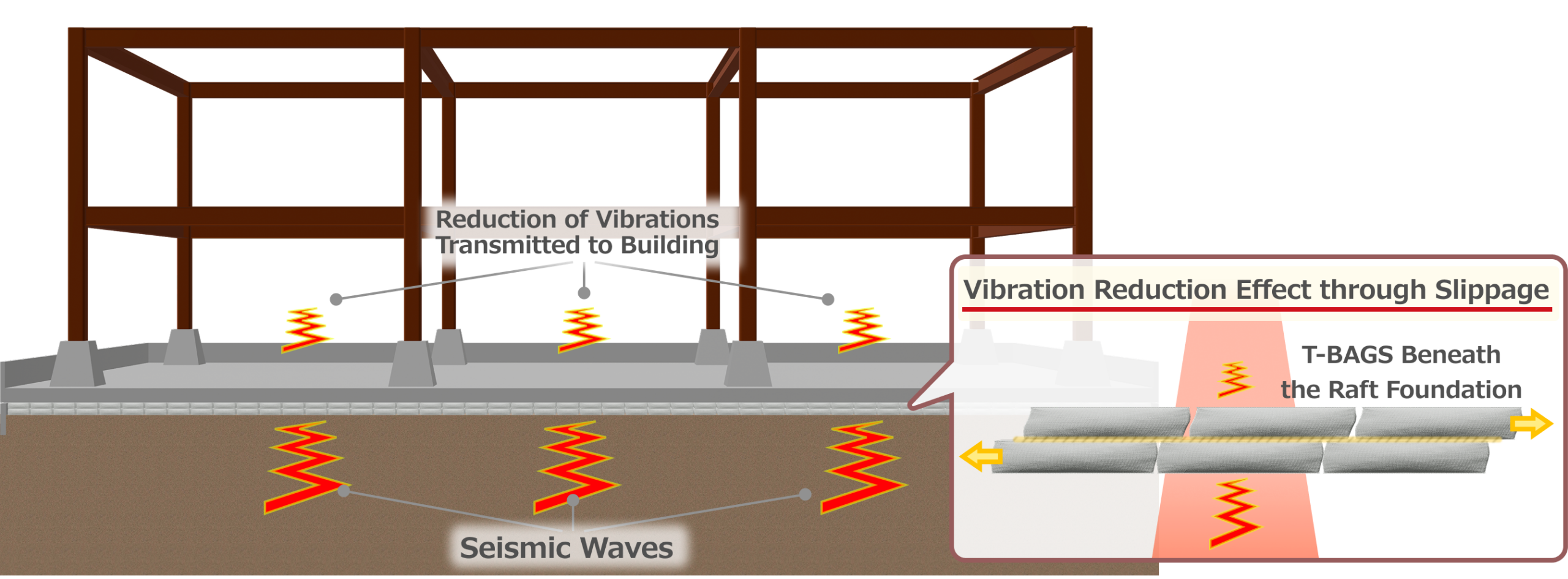
The T-BAGS base isolation system, developed by Takeuchi Construction, is designed to mitigate earthquake vibrations at the foundation level, thereby preventing the building from shaking significantly. As a result, the perceived shaking during an earthquake is significantly reduced.
Performance Comparison Based on Experimental Results
- Typical buildings (without seismic countermeasures): 300–800 gal
- When T-BAGS is used beneath the foundation and ground floor slab: 200–250 gal
The gal is a unit used to measure acceleration; 1 gal = 1 cm/s². The higher the value, the stronger the shaking experienced by occupants.
In this way, the T-BAGS seismic isolation system goes beyond preventing collapse, enhancing both occupant safety and peace of mind by significantly reducing shaking.
Verification of Seismic Vibration-Reduction Effects Through Seismic Analysis
To validate the seismic vibration-reduction performance of the T-BAGS method, Takeuchi Construction Inc. conducted seismic analyses based on observed ground-motion records from past earthquakes.
Analysis Case Study
The animation below compares building response displacements for cases with and without the T-BAGS seismic base isolation system, using earthquake wave records (magnitude M = 7.3) observed in Nakayamate, Chuo Ward, Kobe City, during the Great Hanshin–Awaji Earthquake of 1995 in Japan.
Note: This animation is based on a model of an actual building designed and constructed by our company. The input ground-motion acceleration was calculated based on the site’s geotechnical boring data and observed seismic wave records from the Great Hanshin–Awaji Earthquake. (Displacement scale: 20×)
Comparison of Seismic Response Acceleration at the Top of the Building
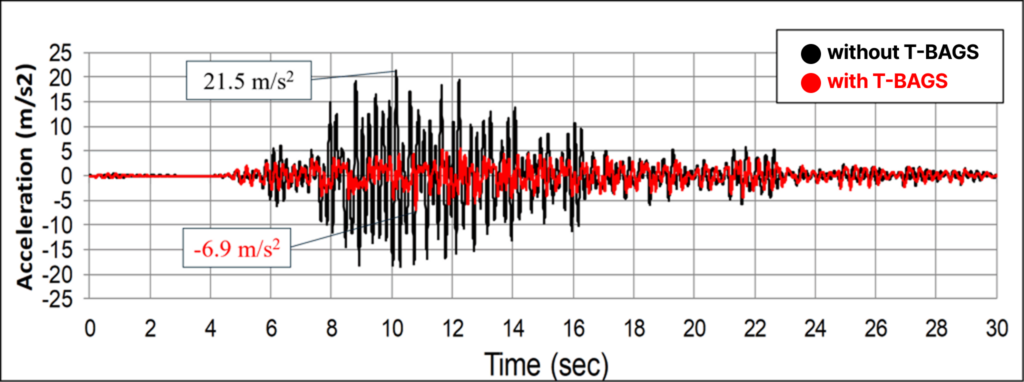
The red line represents the case with T-BAGS, while the black line represents the case without T-BAGS. A comparison of the building’s maximum response acceleration confirms that the peak response is reduced to approximately one-third when T-BAGS is applied.
Seismic Vibration Suppression Effect
The animation below illustrates the slippage behavior between the T-BAGS soil bags (scale: 1×).

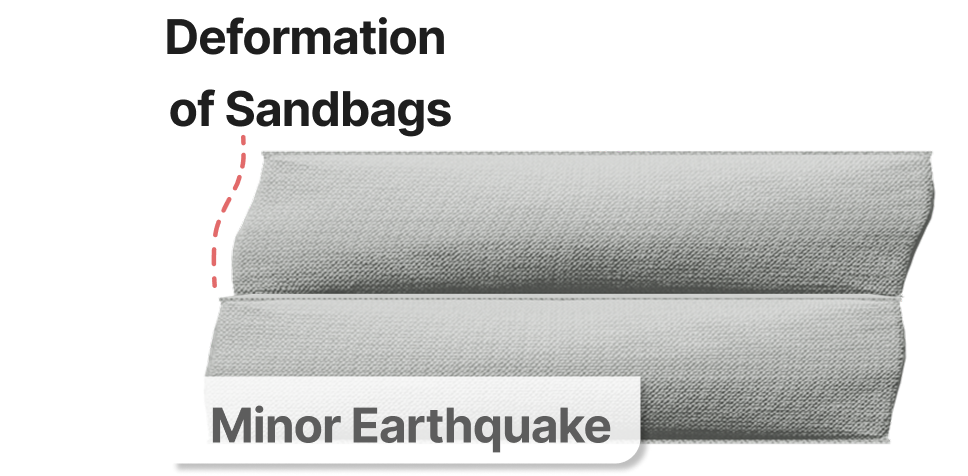
In the Case of Minor Seismic Shaking:
Seismic isolation effect: The sandbags undergo shear deformation, thereby preventing seismic vibrations from being transmitted to the building.
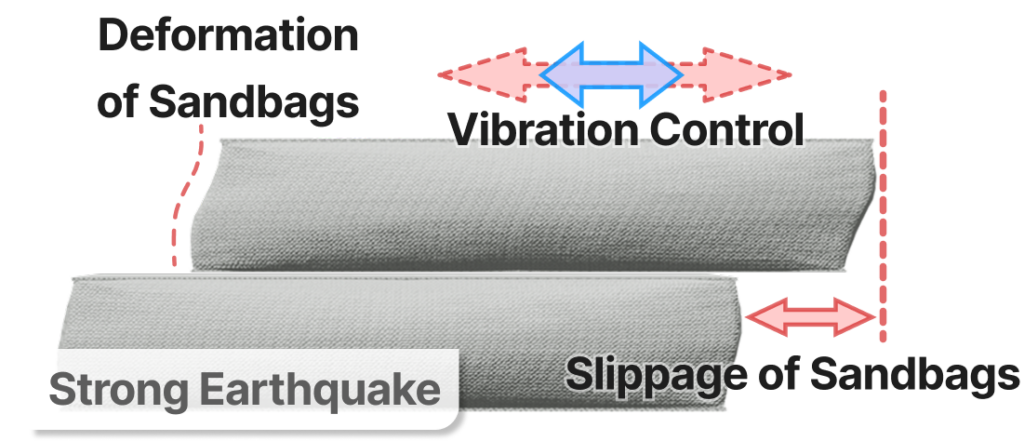
In the Case of Strong Seismic Shaking:
Seismic isolation effect: The sandbags slip laterally, reducing the vibrations transmitted to the building.
Vibration control effect: The sandbags undergo shear deformation, rapidly damping and arresting the building’s vibrations.
Features and Advantages
1. Applicable to Soft Ground Conditions
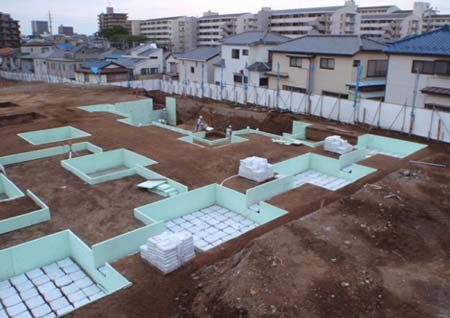
By combining it with the TNF 2.0 method, it is suitable for use on soft ground conditions.
2. Low-Cost

Approximately one-third of the cost of rubber seismic isolation devices.
3. Maintenance-Free with Long-Term Durability

・High durability (approximately 250 years)
・Capable of withstanding loads of up to 4,800 kN/m²