


No earthquake damage
Initiatives Toward Zero Earthquake Damage
Liquefaction Countermeasures
To address soil liquefaction that occurs during earthquakes, the TNF 2.0 Method suppresses loss of bearing capacity and differential settlement through shallow ground improvement. Based on damage-free performance during the Noto Peninsula Earthquake and “shear strain evaluation” using FEM time-history analysis, this section provides a detailed introduction to the differences from pile foundation methods and advanced countermeasures using the TNF Hybrid Method.
Reports on Earthquake-Affected Properties
Noto Peninsula Earthquake (2024)
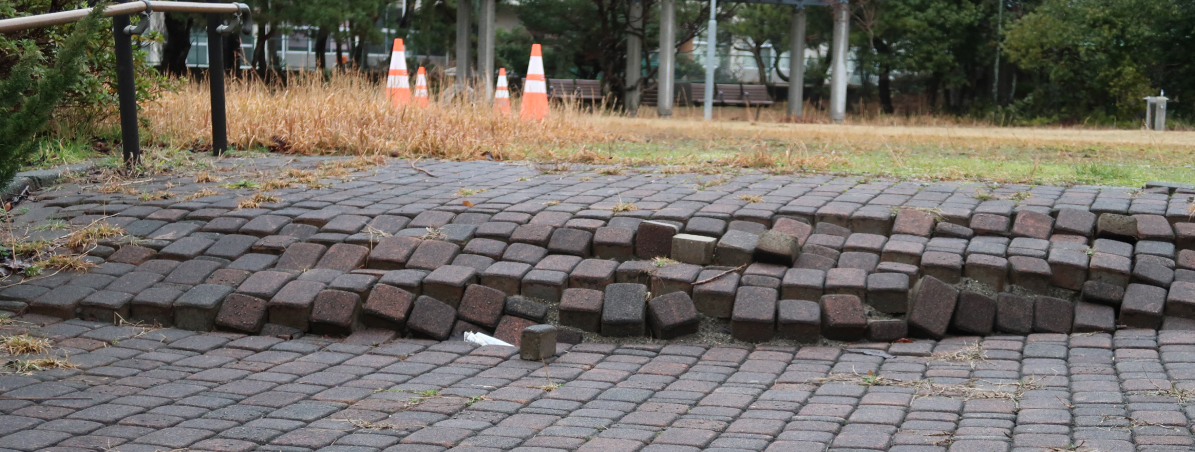
Buildings constructed using the TNF Method showed almost no settlement and were able to continue normal operations. At the same time, challenges related to the extent of ground improvement in exterior areas became evident, highlighting the need to extend countermeasures to the entire site.
Report on Properties Affected by the Noto Peninsula Earthquake
Tottori Earthquake (2016)
The ground conditions consisted of sandy soil in the upper layer and cohesive soil in the lower layer. While nearby buildings supported by pile foundations experienced significant effects from shaking, including level differences and interior damage, no issues such as uplift or differential settlement were observed at all in buildings constructed using the TNF Method.
Report on Properties Affected by the Tottori Earthquake
Great East Japan Earthquake (2011)
On soft ground primarily composed of silt layers, the enclosure effect of the full-area improved layer proved effective, preventing settlement and level differences caused by liquefaction and allowing continued operations. Although liquefaction occurred in some surrounding areas, buildings constructed using the TNF Method responded integrally with the ground, and no major damage was observed.
Report on Properties Affected by the Great East Japan Earthquake