


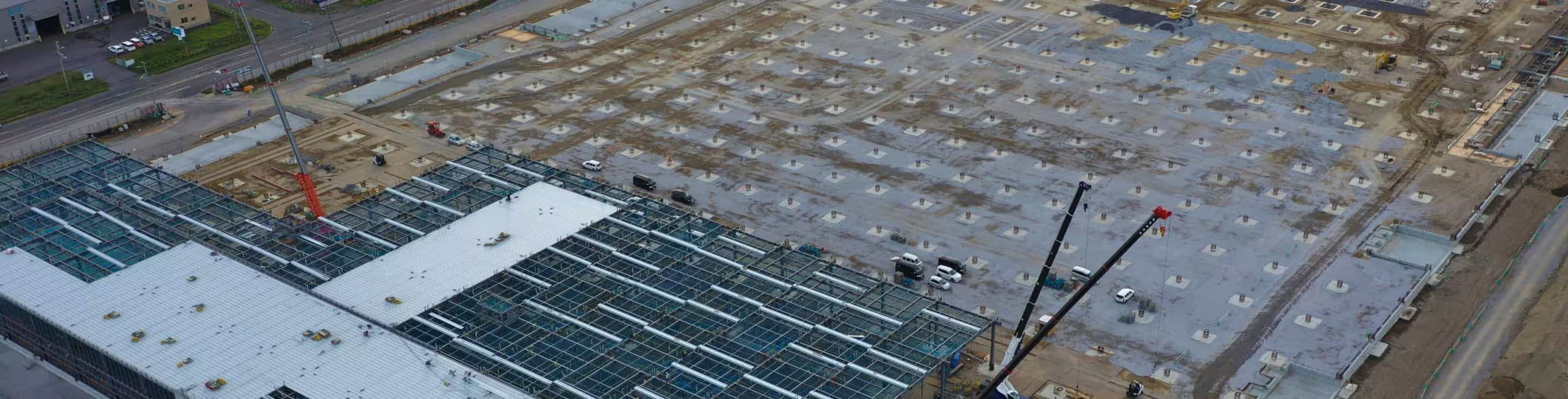
Report on Properties Affected by the Great East Japan Earthquake
Property Report: Comparison Between Conventional Methods and the TNF Method — Great East Japan Earthquake
“Seismic Intensity 6−”: Liquefaction Effectively Suppressed
- The upper soil layer at this site consists of a silt layer deposited to a depth of approximately 19 m.
- The minimal impact observed from the earthquake is believed to be due to the building responding integrally with the full-area improved ground layer, which reduced seismic motion input between the bottom of the improved layer and the underlying ground.
- The confinement (“enclosure”) effect provided by the full-area improved layer clearly demonstrates that the occurrence of liquefaction was effectively suppressed.
- Even if liquefaction were to occur locally, the full-area improved layer resists it integrally.
| Property Name | Construction Period | Improved Area (m2) | Improvement Volume (m3) | Scale | Structure Type |
| Home Improvement Store (name withheld) | Apr. 2009 | 8,989 | 17,618 | Single-story | Steel structure |
| Retail Store (name withheld) | Apr. 2009 | 2,485 | 5,322 | Single-story | Steel structure |
| Retail Store (name withheld) | Apr. 2009 | 2,630 | 6,602 | Single-story | Steel structure |
TNF Method
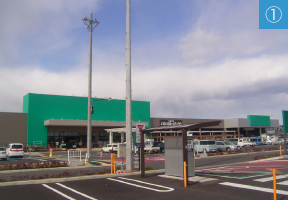
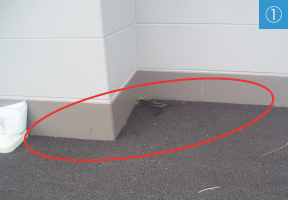
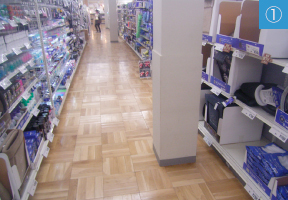
Nearby Conventional Construction
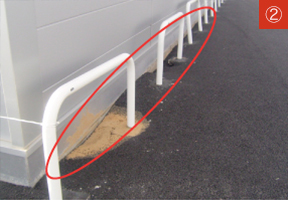
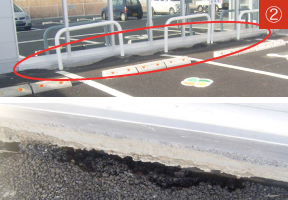
Gap formed between building and pavement (bottom)
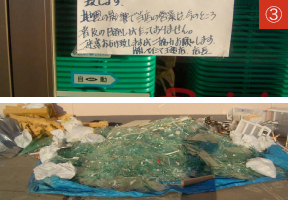
Large cracks observed in the parking area (bottom)
“Seismic Intensity 6+”: No Uplift or Structural Failure Observed
- The upper ground layer at this site consists of loam deposited to a depth exceeding 10 m.
- While strong shaking acts directly on buildings supported by piles, buildings with foundations constructed using the TNF Method are considered to experience reduced seismic intensity.
- Even in the event of ground settlement, no uplift-related or similar structural issues were observed.