About the Use of BIM
Overview of BIM
BIM (Building Information Modeling) is an information management process used in construction projects.
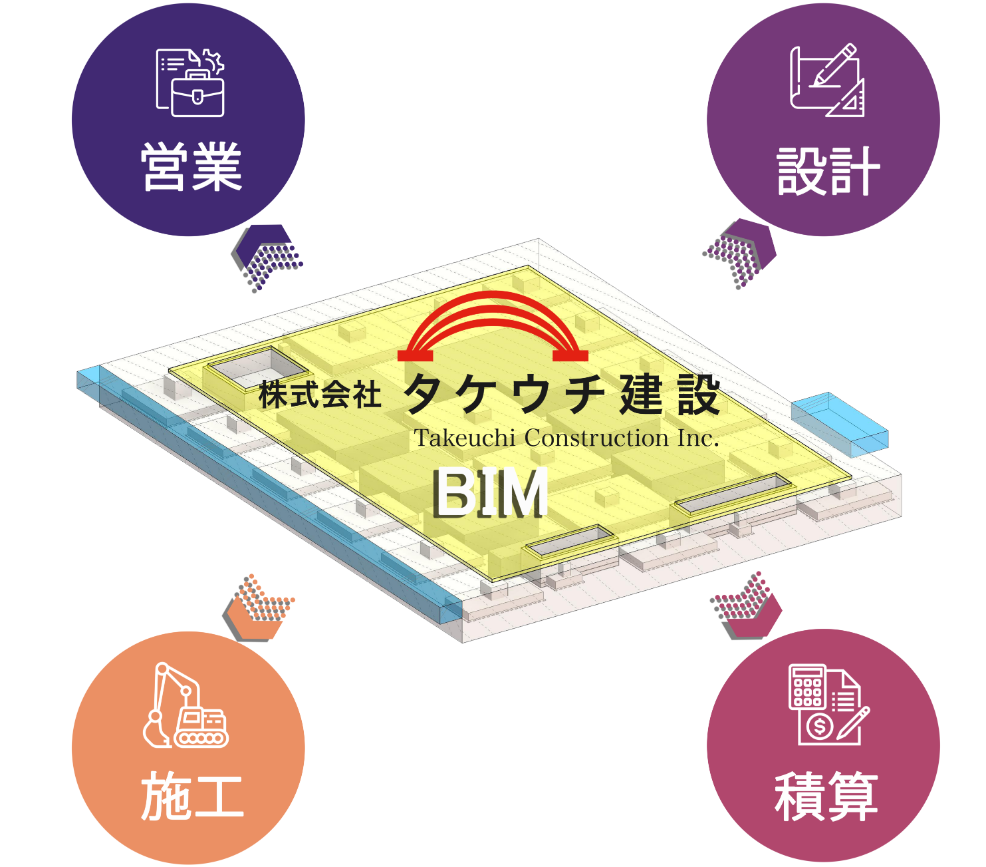
By storing and centrally managing building attribute information, all members involved in each phase—design, construction, cost estimation, and maintenance—can access the necessary information in a timely manner, enabling smooth collaboration.
Takeuchi Construction × BIM
At Takeuchi Construction, we actively utilize BIM to ensure that projects are carried out accurately and efficiently.
We use Autodesk Revit to model buildings, including those incorporating our TNF construction method.
From 3D models created in Revit, drawings such as construction drawings and quantity data for cost estimates can be automatically generated, reducing human error and shortening project timelines through decreased work time.
Design
We create 3D models of foundations and ground improvement using Revit.
By generating design drawings from a single model, inconsistencies between architectural and structural drawings can be reduced.
In addition, areas that are difficult to identify in 2D drawings—such as clashes—can be checked and reviewed in 3D, enabling a smooth transition to the construction phase.
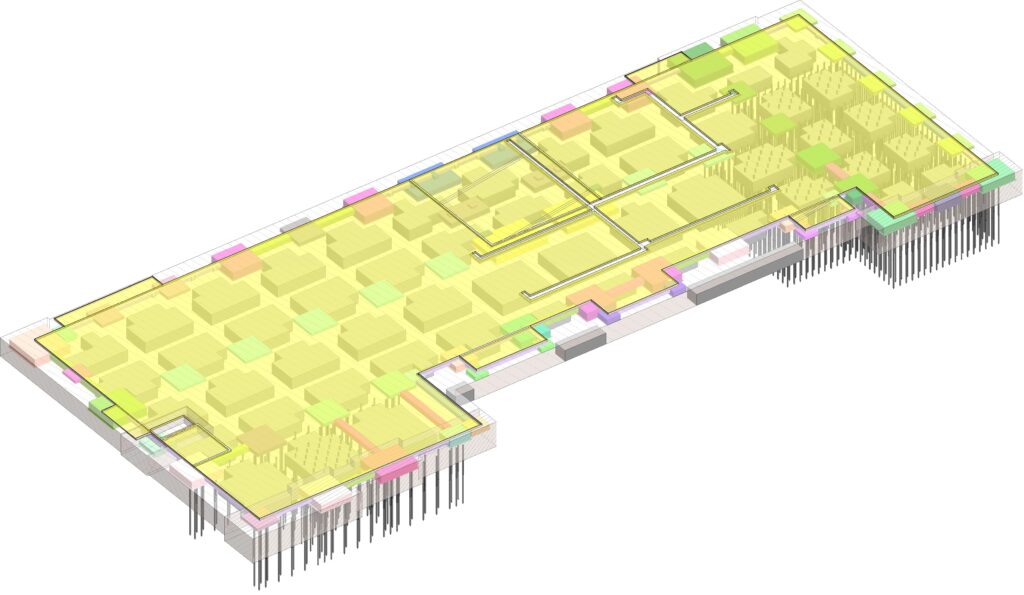
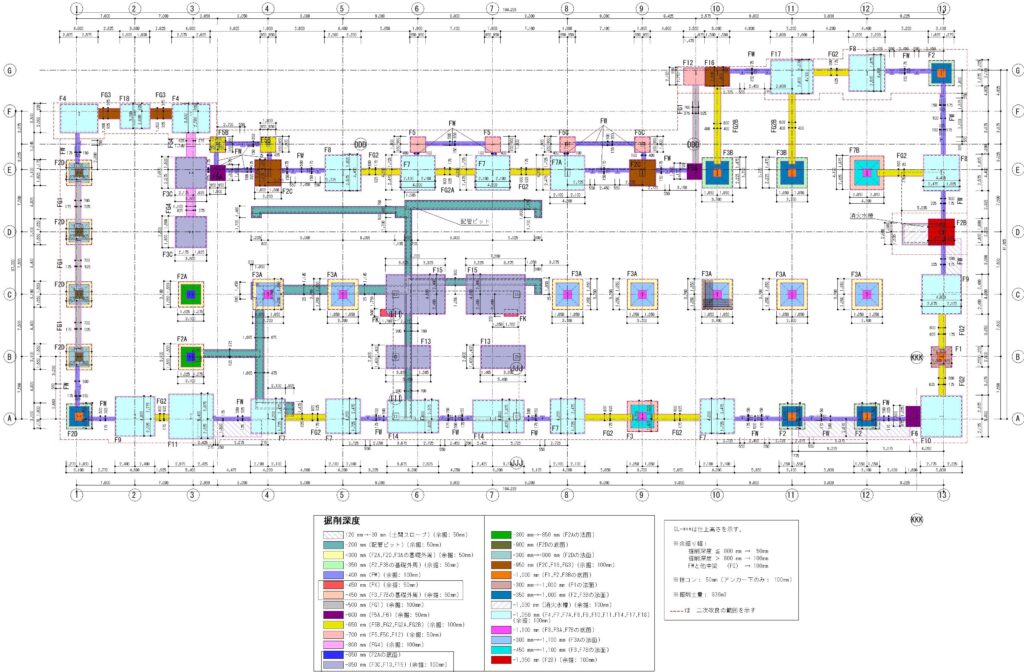
Automatic Generation of Various Drawings from 3D Models
Construction
Based on the model from the design phase, construction drawings such as excavation drawings are created.
Because changes made to the design model are continuously reflected in the construction model, inconsistencies between departments are reduced, leading to smooth communication between designers and construction personnel.
In addition, by utilizing 3D models with ICT construction machinery, it is possible to reduce manpower while achieving high-quality construction.
Cost Estimation
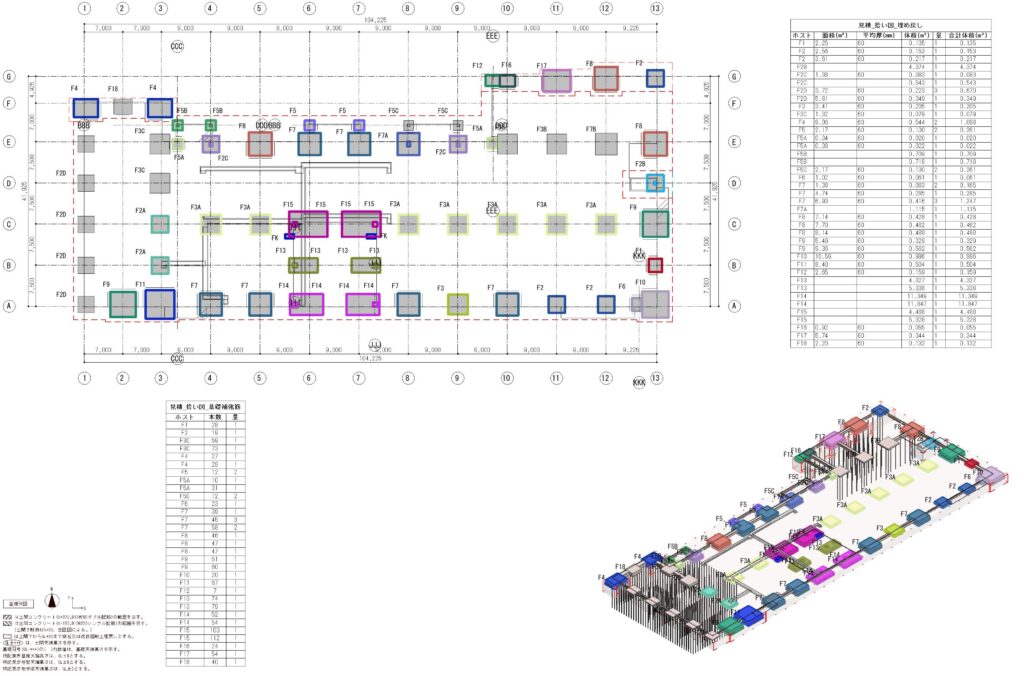
Based on the construction-phase model, quantities are automatically calculated to create cost estimates.
By automatically calculating quantities, omissions and duplicate counts are prevented, enabling accurate and efficient preparation of cost estimates.
In addition, because quantities are automatically updated when the model is modified, design changes can be handled smoothly.
Sales
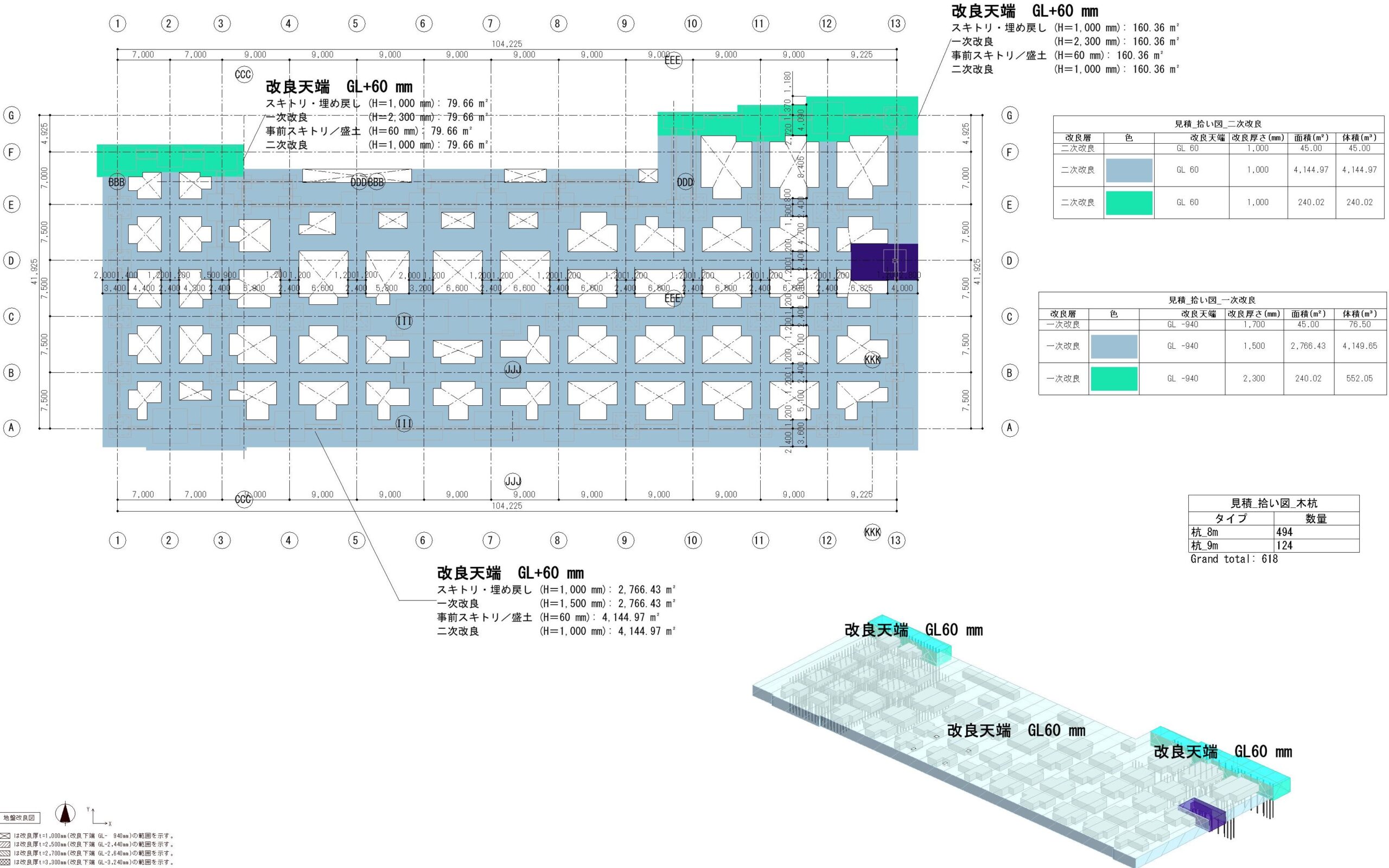
The 3D models and drawings created in each phase are used as communication tools with clients.
By using 3D models, it is possible to clearly explain areas that are difficult for clients to visualize, helping to prevent misunderstandings and gaps in perception.
In addition, because model changes are smoothly reflected in cost estimates, we can quickly submit revised estimates to clients for design changes or value engineering (VE) proposals.
Developing Revit Add-ins
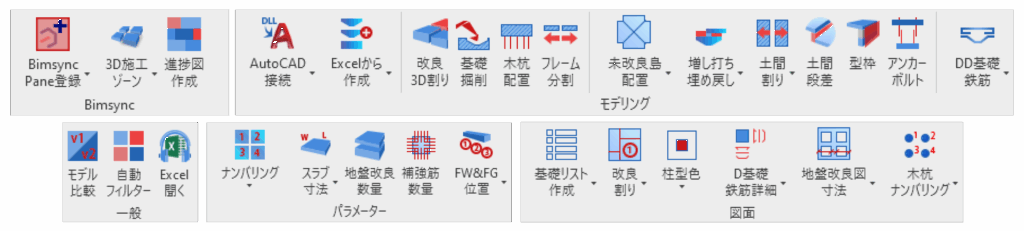
To further improve productivity, our company develops its own Revit add-ins in-house.
We have developed tools that automatically create models for elements such as ground improvement, foundations, slabs, and pits, as well as tools for automatic quantity takeoff for cost estimation, automatic generation of rebar fabrication drawings, and other tools that support high-volume tasks in the estimation and construction departments.
These add-ins contribute to the more accurate and efficient execution of projects.